
Gym Management Software in India: Website, App or Custom System?
Picture a Monday morning at a busy gym. A member messages on WhatsApp asking to freeze her membership for two weeks of travel. The receptionist opens a spreadsheet, counts days on a wall calendar and types a new end date. Last week's freeze request sits in another chat. The gym is imagined. The Monday probably is not.
The honest answer first
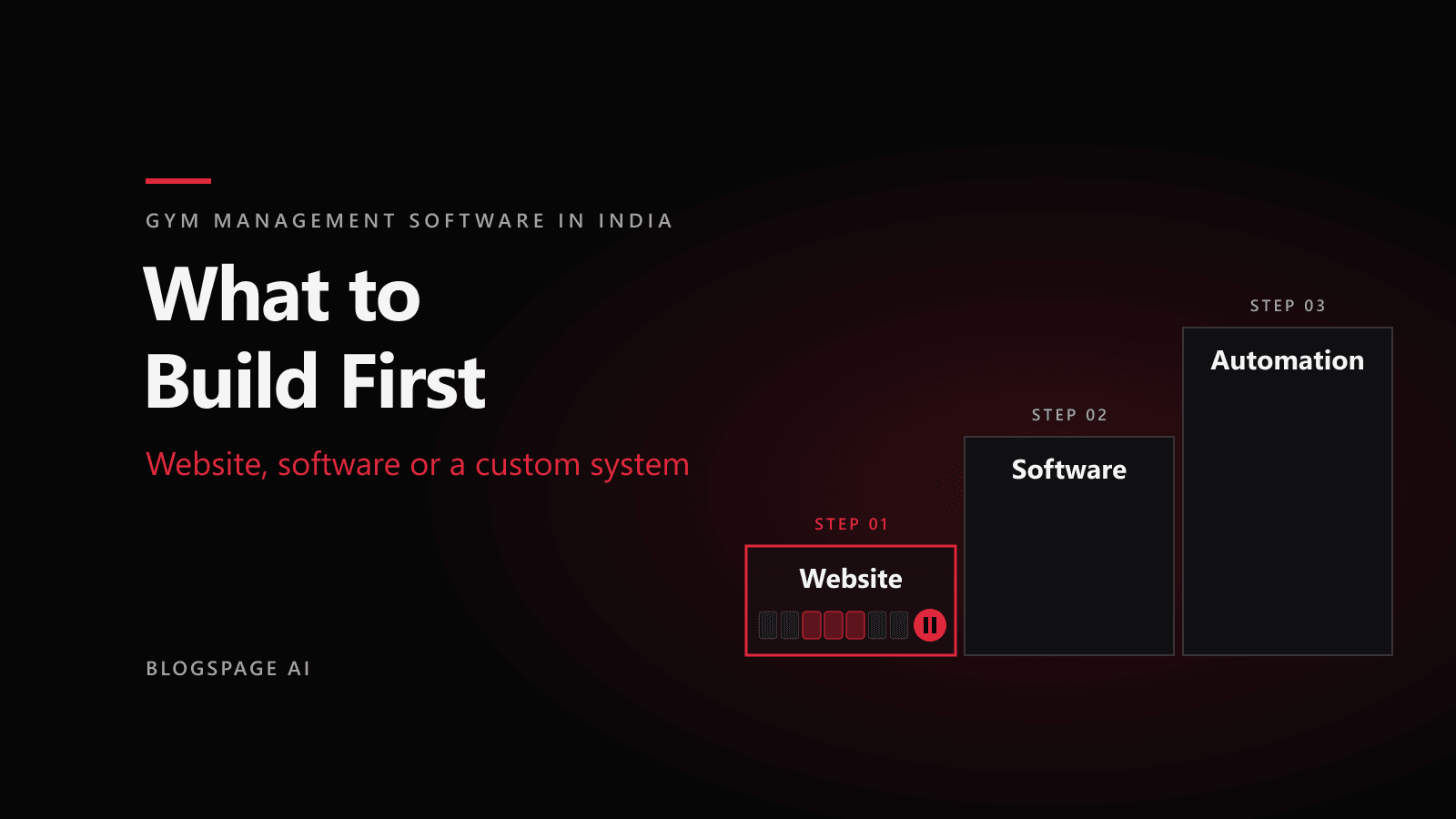
Before you shortlist gym management software in India, get the order right. Most gyms should start with a website and a clear enquiry path. When renewals, freezes and attendance start eating the front desk's day, ready-made software is often the right second step, and it is usually quicker to adopt than anything built from scratch. A custom system makes sense only when your way of working genuinely does not fit the box.
That is an unusual thing for an agency that builds custom systems to say first, but it is the order we would follow ourselves. This guide compares the four options plainly, uses the membership freeze as a practical test of whether you have outgrown what you have, and ends with the questions to ask any vendor or developer. It names no software brands and quotes no prices or timelines, because both depend on your gym.
Gym management software, app or custom system: four options compared
A website with a clear enquiry path
What it solves: people can find you, understand your programs and timings, and message you with some context. What it does not: it does not track who is a member, when they renew, or how many days they have paused. When it fits: almost every gym, as the first step, and for many gyms it stays the main digital investment for a long time. The trade-off: it ends at the conversation. Everything after that still happens in your team's heads, chats and registers.
If you are at this stage, our guide to what a gym website should actually do covers the structure, and turning website visitors into first visits covers the enquiry path.
Ready-made gym management software
What it solves: a gym membership management system out of the box. Typically members, plans, renewals, payments, attendance and reminders in one place, set up in your browser. What it does not: it works the way the vendor designed it. If your packages, freeze rules or multi-branch setup are unusual, you adapt to the software, not the other way round. When it fits: most independent gyms and small chains whose problem is "we track everything by hand". The trade-off: a recurring subscription, your data on someone else's platform, and limits on how far you can change things.
A quick search shows many Indian vendors, and many of them advertise WhatsApp reminders, GST invoicing and QR attendance. That is a sign these needs are common, and common needs are exactly what ready-made products do well.
A member app
What it solves: a branded place on members' phones for bookings, check-ins, plan details and notifications. What it does not: an app does not fix messy records behind it. If the data is wrong in the spreadsheet, it is wrong in the app. When it fits: gyms with class bookings, many members who check in daily, or a community the owner wants to keep engaged between visits. The trade-off: gym app development has to be maintained for two phone platforms and updated when they change, and members have to be persuaded to install it. Many ready-made systems include a basic member app, which is often enough.
A custom-built system
What it solves: software shaped around how your gym actually runs. Your packages, your freeze rules, your branches, your reports, connected to your website. What it does not: it does not remove the need to know what you want. Custom gym software development built from a vague brief produces a vague system. When it fits: when you have tried ready-made software, or seriously evaluated it, and can name specifically what does not fit. Common examples are complex packages across branches, a pause policy the software cannot express, or a member experience you want to own completely. The trade-off: a larger upfront project, ongoing responsibility for maintenance, and a dependency on whoever builds it unless you own the code and the accounts.
The gym membership freeze test
Membership freezes are a good test because they happen every week and touch everything: dates, money, records and member trust.
Go back to that Monday. Each freeze request means someone has to:
- find the member's current end date,
- count the paused days, by hand,
- work out the new end date and write it somewhere,
- remember that a second request is sitting in another chat,
- and later, answer "but my membership should end on the 10th" when the two records disagree.
None of this is hard. It is just manual, repeated, and easy to get slightly wrong. A dispute about an end date costs goodwill out of proportion to the few days involved.
Software that handles freezes properly treats each membership as a simple record, a kind of ledger. It holds four things: when the membership started, when it ends, its status (active, paused or expired), and a running count of paused days. Each paused day moves the end date forward by one day, and the record updates itself. Nobody counts on a calendar.
Here is an illustrative example. A membership is due to end on 31 March. The member pauses for 10 days, from 10 to 19 March. The record shows 10 paused days, and the new end date is 10 April. The member can see the same date your team sees.

If a spreadsheet and a careful receptionist handle your freezes without trouble, you have not outgrown your current setup on this test. If freezes regularly cause confusion or disputes, look first at gym membership freeze software among ready-made options. Check that it can express your actual rules, such as minimum pause length, how many pauses are allowed per plan, and whether a pause needs approval. If none can, that is a real reason to consider custom.
Other signs you have outgrown a website
Freezes are one signal. These are others:
- Renewals are chased by hand, from a register or memory, and some are missed.
- Nobody can say quickly who is active today, paused, or expired.
- Check-ins are on paper, or not recorded at all.
- You have no view of how busy the floor is at different hours, so you cannot plan trainers or tell members the quiet times.
- Packages, member messages and accounts live in different places, and someone reconciles them at month-end.
When we design a connected gym system, these are the pieces we plan for: a membership record that recalculates end dates when a member pauses, QR check-in through a member app, reminders for members who have stopped coming, and a simple view of how busy the floor is. To be clear, that is the way we design it, not a product you can sign up for today. On our gym solution page, the website and guidance tools are what we build now, and the member, operations and owner layers are shown as concept previews.

Six questions to answer before you buy or build
Answer these yourself before you speak to any vendor, including us:
- What hurts most today, in one sentence? "Freezes cause disputes" is a good answer. "We need to digitise" is not.
- How many branches, and who needs to see what? The owner, the manager, reception and trainers usually need different views.
- Who will keep the data up to date, and how? Software with stale data is worse than a clean register.
- How do you contact members today? For many gyms in India, conversations already happen on WhatsApp. Whatever you choose should fit that habit, not fight it.
- What must connect to your accounts? Invoices, GST, payments, and whoever does your books.
- What happens to your data if you leave? Can you export members, plans and history in a usable format?
If you cannot name the problem in one sentence, do not build software yet. Buy time, fix the process on paper, and come back when the pain is specific.
Member data and privacy
Member records are not just names and phone numbers. They can include injuries, medical conditions, fitness goals and body measurements. Treat them as sensitive whatever software you use.
In India, the Digital Personal Data Protection Act, 2023 is the law that applies. The DPDP Rules were notified on 13 November 2025 with a phased start. Most of the duties businesses care about, such as notice, consent, security safeguards, erasure and breach reporting, are scheduled to apply 18 months later, around mid-May 2027. In January 2026 the government was reported to be considering a shorter window, mainly for large companies. As of writing (3 November 2026) we have not seen that change notified, so check the current status before you rely on any date.
Practical points that hold either way:
- Collect only what you need to run the membership and train someone safely.
- Keep health details out of analytics tools, ad platforms and exported chat backups.
- Decide who on your staff can see what. Reception may need the end date, not the injury history.
- Ask any vendor where the data is stored and how it is deleted when a member asks.
This is general information, not legal advice. For your own gym, confirm with a qualified adviser.
Questions to ask any vendor or developer
Take this list into every demo:
- Who owns the data and the accounts? It should be your gym, in writing.
- Can you export everything (members, plans, payments, history) whenever you want?
- What is one-time and what is recurring? Setup, subscription, per-member or per-branch charges, messaging costs.
- What happens if the vendor shuts down or you stop paying? How long do you keep access to your data?
- How are WhatsApp reminders handled? From whose number, with what cost, and can members opt out?
- How are freezes, renewals and refunds recorded? Ask them to show the freeze example above, live.
- Can it grow from one branch to several without starting again?
- Who supports it, and how? Hours, language, and a real person to call.
- Is anyone promising more members, lower churn or higher revenue? Treat it as a red flag. Software records what happens. It does not guarantee what happens.
Where Blogspage fits, and where it does not
Our approach follows the same order as this article. Start with brand and digital presence: the website, the guidance tools and a clear enquiry path. Grow into applications and business software when the manual work justifies it. Scale with AI and automation after that. At each step, you own what is built.
Where we do not fit: if your gym's main problem is tracking members, renewals and freezes, and a ready-made product handles your rules, buy the ready-made product. For most gyms it will cost less upfront and be running sooner than anything custom, and we would tell you that in the first conversation. We are useful when the website matters, when your way of working does not fit the box, or when you want the website and the member system to work as one. Pricing is discussed after we understand what your gym actually needs.
What Monday could look like
Back to the receptionist with the spreadsheet. With a membership record that counts paused days, the travelling member's new end date is set once, visible to her and to the team, and the second request from last week is in the same queue as the first. The Monday becomes ordinary, which is the point.
Blogspage AI builds gym websites and custom gym systems, so we have a commercial interest in this decision. The freeze test and the vendor questions work whichever option you choose. If you are unsure which step your gym is on, a short conversation is the easiest way to find out. Our earlier piece on why many gym websites fall short covers the website side of that question.
Frequently asked questions
- Should a gym start with software or a website?
- Most gyms should start with a website and a clear enquiry path. Ready-made software is often the right second step once renewals, freezes and attendance are tracked by hand. A custom system makes sense only when your way of working does not fit ready-made software.
- When is ready-made gym management software the right choice?
- When your main problem is tracking members, renewals and freezes by hand, and a product can express your actual rules for packages, pauses and branches. For most gyms it costs less upfront and is running sooner than anything custom.
- When does custom gym software development make sense?
- When you have tried or seriously evaluated ready-made software and can name specifically what does not fit, such as complex packages across branches or a pause policy it cannot handle. If you cannot name the problem in one sentence, do not build software yet.
- How should a membership freeze change the end date?
- Each paused day should move the end date forward by one day, recorded automatically. For example, a membership ending on 31 March with a 10-day pause ends on 10 April, and the member sees the same date your team sees.
- Does my gym need a member app?
- Only if you have class bookings, many daily check-ins, or a community you want to keep engaged between visits. Many ready-made systems include a basic member app, which is often enough. An app does not fix messy records behind it.
- Does India's data protection law apply to gym member records?
- The Digital Personal Data Protection Act, 2023 covers personal data handled digitally, and member records can include sensitive details such as injuries and goals. Its Rules start in phases, with most business duties scheduled for around mid-May 2027, so check the current status. This is general information, not legal advice.
Want a system like this for your business? Get in touch.