
Website vs Instagram for Small Business: What I Learned From Talking to Local Business Owners
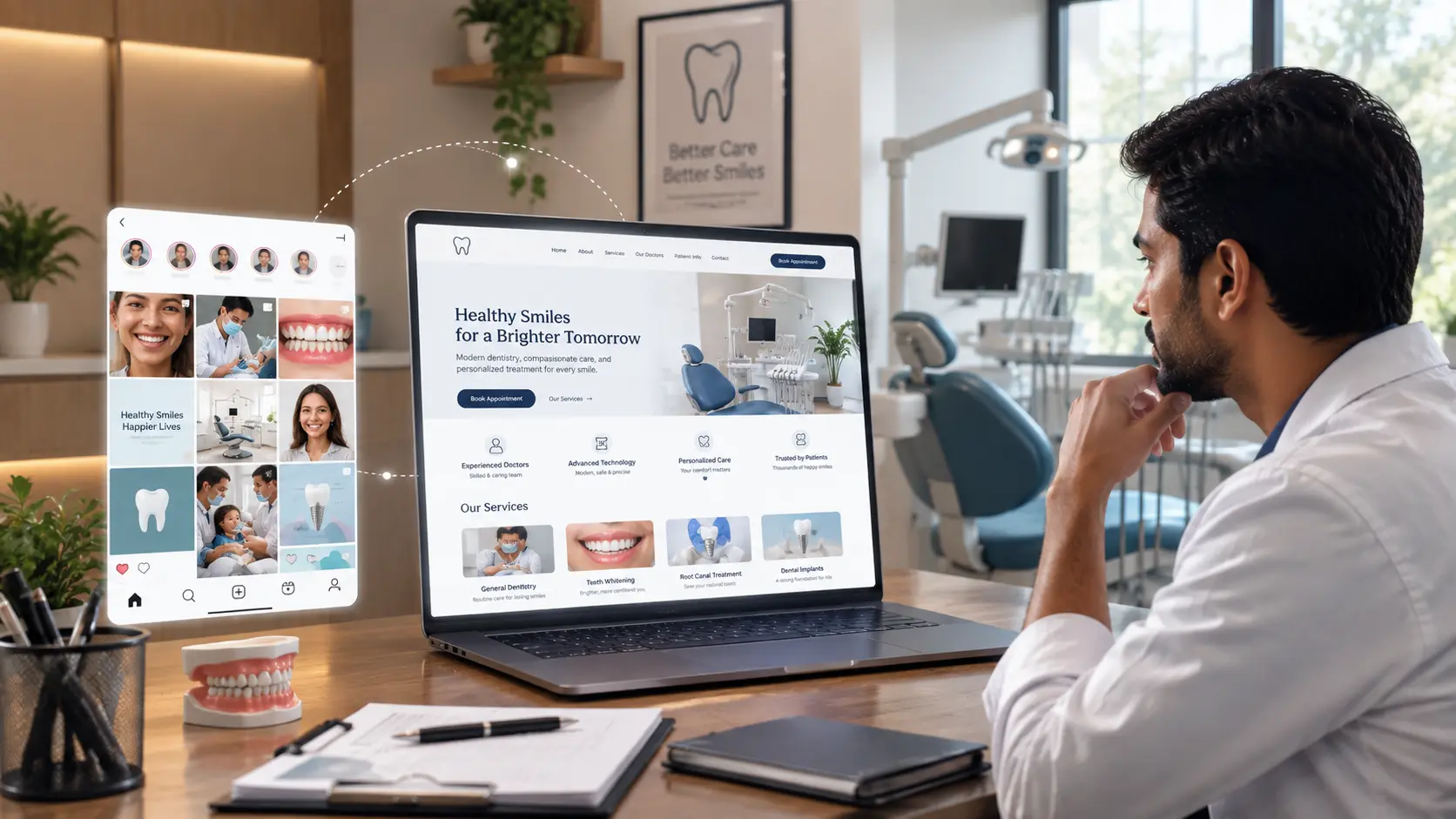
“How many Instagram followers will you give me?”
That was one of the first questions a dentist asked me when I went to talk about his website.
Honestly, that wasn't the question I was expecting.
I had gone there as a web developer and technology consultant. I wanted to understand his existing online presence, look at his website situation, and explain what I could build for his business.
Instead, the conversation immediately moved toward Instagram.
And that wasn't an isolated experience.
While speaking with local business owners, particularly gym owners and dental clinic owners, I kept seeing the same pattern. Many of these businesses already had strong Google reviews, active Instagram pages, good content, loyal customers and years of experience behind them.
Some of them had hundreds of Google reviews with ratings around 4.8 or 4.9.
Some were consistently creating Instagram Reels.
Some were even spending money every month on digital marketing and Google Ads.
But when the conversation came to the website, the response was often very different.
“Do I really need one?”
“What will the website actually do for me?”
“I already have Instagram.”
“My customers already know me.”
“People are finding me through Google.”
And, perhaps the most common concern of all:
“How much is this going to cost me?”
After having these conversations, I started looking at the website-versus-Instagram question differently.
I don't think the real question is website or Instagram?
The real question is:
What job is Instagram doing for your business, what job should your website do, and how should the two work together?
This is what I learned from actually talking to local business owners.
Why I Started Talking to Local Businesses
I've spent around eight years working at GoDaddy.
During that time, I spoke with business owners, web developers, technical teams and customers with very different levels of technical knowledge. I saw how larger businesses approached technology, how developers provided services to smaller businesses, and how business owners thought about websites, domains, hosting and online services.
But most of those conversations weren't with very small, local businesses.
So when I started working on my own agency, I wanted to get closer to that market.
I started approaching businesses around my local area in Hyderabad, often within a couple of kilometres of where I was working.
There was a practical reason for that.
When you tell a business owner that you're local, that you're from the same city and that you are actually researching businesses in their locality, the conversation feels different.

I remember calling one gym owner and explaining that I was nearby and was researching local businesses.
His response was immediate:
“Okay. Just come to my office and meet me.”
That moment reinforced something for me.
Local businesses are built on relationships and trust. Being physically close doesn't automatically create trust, of course, but it can make the first conversation easier.
I also wanted to see what was actually happening online.
When I searched local businesses, I started noticing an interesting gap.
Some had no website.
Some had websites that clearly hadn't been touched in years.
And some had surprisingly strong Instagram and Google profiles while their websites were almost unusable.
That gap became one of the reasons I wanted to understand the market more deeply.
I Chose Gyms and Dental Clinics for a Reason
My current focus is health and fitness.
I've already worked on technology in this broader space, including an enterprise-level, multi-tenant meal-delivery application connected to health and fitness.
But the reason I became particularly interested in gyms and dental clinics goes beyond my own technical background.
These are highly local businesses.
A gym usually serves people from a specific neighbourhood or surrounding area.
A dental clinic works in a similar way.
People aren't normally travelling across an entire country to join a gym or visit a local dentist. They are making decisions based on locality, reputation, convenience and trust.
And these businesses have to maintain that trust continuously.
A gym can't simply open and stop marketing.
It has to continuously:
- attract members,
- retain members,
- demonstrate its value,
- remain visible,
- build trust,
- compete with nearby gyms,
- and communicate why someone should choose it.
The same applies to dental clinics.
A patient isn't necessarily looking for a dentist only once. A dental relationship can continue over a long period, particularly when treatment, follow-ups or ongoing care are involved.
That makes them interesting businesses to study from a digital perspective.
They have an interesting mix of online channels:
Google Business Profile, reviews, Instagram, advertising, WhatsApp and, potentially, a website.
Google itself allows business profiles to surface information such as reviews, social links and action links for things such as appointments, reservations and orders, which reinforces the idea that local businesses are dealing with several complementary digital touchpoints rather than one single channel.
What I Thought Business Owners Would Say
My expectations were heavily influenced by my earlier experience.
Five to seven years ago, when I was having many of these conversations, websites were much more central to the discussion.
Instagram wasn't dominating business conversations in quite the same way.
So when I started approaching local businesses, I expected something simple.
I thought the conversation would go something like:
“I need a website.”
“Okay. What will you build?”
“How many pages do I need?”
“How long will it take?”
I was ready to explain the whole ecosystem.
The domain.
DNS.
Hosting.
SSL.
Security.
Content.
Payment gateways.
Maintenance.
Future support.
I also expected to explain that a business doesn't necessarily need a huge website.
A one-page website could be enough in some cases, while another business might need several pages.
I even expected pricing to be relatively straightforward.
What I wasn't expecting was that many owners would challenge the underlying value of having the website at all.
The First Conversation Wasn't About the Website
One gym owner gave me a particularly interesting example.
Before meeting him, I had checked his existing website.
It was effectively broken.

So I created a premium, interactive, storytelling-oriented single-page concept for his business and shared it with him.
I assumed he would look at it and say:
“This looks good. Let's build the remaining pages.”
He didn't.
Instead, he started talking about his business.
His gym was already:
- premium,
- aesthetic,
- locally famous,
- focused on women,
- and getting good membership numbers.
His question was essentially:
“How are you going to help me get more memberships?”
He didn't want to talk about the website.
He told me directly that he didn't think the website would help his business.
He also explained that he had already invested significant effort into SEO.
His old website had dozens of articles.
He had researched keywords.
He had looked into backlinks.
He had tried to build authority through content.
He was also running Google Ads locally.
He told me he was keeping around ₹15,000 per month aside for digital marketing-related activities, including content creation and promotion.
So this wasn't a business owner who didn't understand digital marketing.
He did.
He simply didn't see the website as the most important part of that system anymore.
And that's a very different problem.
“I Already Have Instagram”
The dentist conversation made this even clearer.
When I went to meet him, his first question was:
“How many Instagram followers will you give me?”

Again, I had come to discuss a website.
But his mental model of digital growth started with Instagram.
He told me that his clinic had been operating in the same locality for around twenty years.
He had built a good reputation.
He had invested in the clinic itself.
He had an established name.
He was using Instagram.
People were already coming to him.
So from his perspective, a website didn't immediately solve an obvious problem.
And honestly, I understand why.
If you already have:
- a strong Google rating,
- hundreds of reviews,
- a good Instagram profile,
- regular content,
- a physical location,
- and existing customers,
it's reasonable to ask:
“What exactly am I getting from a website?”
That's the question a good consultant needs to answer.
Not by saying that everything the business is already doing is wrong.
But by showing where the missing piece fits.
The Money Fear Is Real
Another recurring issue was pricing.
One dentist told me that his existing provider was asking around ₹10,000 per month.
A gym owner also asked whether the website cost would recur every year when we discussed a project in the ₹30,000–₹35,000 range.
These conversations showed me that many small business owners don't necessarily know what they are actually paying for.
And I don't blame them.
If you're not technical, someone can tell you:
You need better hosting.
You need security.
You need a bigger server.
You need backups.
You need SSL.
You need maintenance.
You need another plugin.
You need another subscription.
Some of those things may genuinely be necessary for particular projects.
But when all of these things are presented together, the business owner can start to feel that a website is some gigantic technical machine that constantly consumes money.
That's where the fear comes from.
I've also seen the opposite.
Some people think a website should cost ₹500 or ₹1,000.
The problem with that approach is that the cheapest possible implementation isn't necessarily the best business decision.
A business website is representing your business.
So my philosophy is somewhere between those two extremes.
Don't overcharge someone because they don't understand technology.
But don't build something poor simply because they have a limited budget.
Right-size the solution.
The Businesses I Met Were Already Online
This was probably the most interesting pattern I noticed.
These businesses weren't offline.
They were already online.
A typical business might have:
Google Business Profile
4.8 or 4.9 stars.
Hundreds of reviews.
Photographs.
Location.
Business details.
Regular Reels.
Good photography.
Healthy follower counts.
Consistent content.
Advertising
Some businesses were running Google Ads targeting people within a few kilometres of their location.
Physical presence
Established offices, clinics or gyms.
In other words, their digital presence wasn't empty.
It was just fragmented.
And often, the website wasn't part of the picture.
That's when I started asking myself:
If all these other channels are working, what is the website supposed to do?
Then I Looked at the Websites
And the answer became clearer.
Some businesses did have websites.
But they weren't really maintaining them.

Many of the older websites I encountered appeared to be built with WordPress, and over time things had started falling apart.
Plugins or themes were outdated.
Pages were broken.
Links weren't working.
Images weren't loading correctly.
Some websites were only partially loading.
Some were throwing server errors.
Some had old information.
Some had confusing navigation.
Some had no obvious call to action.
And some redirected visitors from the business's website to a third-party site just to fill out a contact form.
Think about that experience as a customer.
You search for a business.
You see that it has good reviews.
You click the website.
You see an old-looking page.
You click “Enquire Now.”
Suddenly you're sent to another website.
Now you're wondering:
“Is this really their official form?”
“Should I enter my details here?”
“Why didn't they build this properly?”
That may sound like a small UX issue.
But trust is often built through many small signals.
A broken link.
An outdated page.
A confusing navigation menu.
An old gallery.
A strange redirect.
All of these things can make a business look less organized than it actually is.
And that led me to another realization:
Having a website and having a useful website are two different things.
The Conversation Changed When I Stopped Selling a Website

The biggest shift happened when I stopped trying to convince people that their current strategy was wrong.
I didn't want to tell a gym owner:
“Instagram is useless.”
That would be ridiculous.
Instagram can be extremely valuable.
I didn't want to tell a dentist:
“Google reviews don't matter.”
Of course they matter.
Instead, I started connecting the dots.
I would say:
Your Instagram is valuable.
Your Google Business Profile is valuable.
Your reviews are valuable.
Your advertising is valuable.
But each of them has a different role.
The website is not supposed to replace Instagram.
It is not supposed to replace Google.
It is supposed to become part of the larger business ecosystem.
That changed the conversation.
Instead of:
“Do I need a website?”
we started discussing:
“Where does the website fit into everything you're already doing?”
That's a much better question.
Instagram Is a Channel. Your Website Is an Owned Asset.
This was one of the arguments I made repeatedly.
Instagram is powerful.
Use it.
Google is powerful.
Use it.
WhatsApp is useful.
Use it.
But don't confuse a third-party platform with an asset your business directly controls.
Platform policies can change.
Features can change.
Algorithms can change.
The importance of a particular platform can change.
We've seen entire platforms rise, dominate attention and then disappear from particular markets. TikTok's ban in India is a good example of how quickly a platform ecosystem can become unavailable to businesses operating in that market.
The point isn't that Instagram is going away.
The point is much simpler:
Don't put your entire digital identity in someone else's hands.
Your website, hosted on your own domain, gives you a place where you control the presentation.
You decide:
- what your business says,
- how it looks,
- what services it explains,
- how it tells its story,
- what information customers see,
- how visitors contact you,
- and how the customer journey works.
You should still leverage Instagram and Google.
But they should be channels that contribute to your digital presence, not the entire foundation of it.
A Website Can Show the Business Behind the Profile
Imagine searching for a gym.
You find:
4.9 stars.
Hundreds of reviews.
Great.
Then you find Instagram.
There are Reels.
People are working out.
The trainers are visible.
The place looks good.
Again, great.
But then you want to know more.
Who runs the gym?
How long has it been operating?
What services are available?
Who are the trainers?
What does the gym actually specialize in?
What do customers say?
Where exactly is it?
What's the membership process?
How do you contact them?
A website can bring all of that together.
And that's where I think websites are particularly useful for businesses that depend on trust.
For a short-term purchase, you may not research much.
But if you're going to:
- join a gym for six months,
- buy a yearly membership,
- start treatment with a dentist,
- spend significant money on a service,
- or build a long-term relationship with a local business,
you are probably going to look more closely.
Google itself exposes business information such as review scores, review counts and links that help customers take actions through Search and Maps. A website can then provide the deeper, structured information that a small business controls itself.
That's why I don't see the website as a competitor to Instagram.
I see it as the place where the customer can go deeper.
The Website Doesn't Replace the Handshake
I often think about it this way.
When someone physically walks into your clinic, gym or office, they get a much richer experience.
They see the environment.
They meet the people.
They observe how you operate.
They ask questions.
They form an impression.
A website can't completely replicate that.

But not everybody can physically visit your business.
Everybody who is interested in your business can potentially visit your website.
So the website extends your reach.
It doesn't replace the handshake.
It creates the opportunity for the handshake.
For me, a website is a space you've created so that people can come and understand your business even when you cannot personally talk to them.
They can discover:
Who are you?
What do you do?
How long have you been doing it?
What do other customers say?
Who is part of the business?
What services do you provide?
How can I contact you?
Why should I trust you?
That is valuable.
Does Every Small Business Need a Huge Website?
No.
And I think this is another area where the website industry often makes things unnecessarily complicated.
I don't believe in asking:
“Do you need a big website?”
I think the better question is:
“How much website does your business actually need?”
The website should reflect the business.
Suppose you run a small gym.
You provide memberships.
That's it.
No personal training.
No trainer academy.
No nutrition programs.
No online courses.
No workshops.
In that situation, a single high-quality page might be enough.
It could contain:
- the story of the gym,
- membership information,
- pricing where appropriate,
- location,
- gallery,
- testimonials,
- important FAQs,
- and a clear contact or enquiry option.
That's perfectly valid.

Now imagine another gym.
It provides:
- memberships,
- personal training,
- nutrition,
- workshops,
- coaching,
- trainer education,
- online programs,
- and other services.
Now the website should grow with the business.
Those services deserve proper structure and dedicated information.
So my philosophy isn't:
Bigger website = better website.
It's:
The website should be as complete as the business requires.
My Pricing Philosophy: Quality Is Not Negotiable
I want to build websites that actually feel like the business invested in them.
Even a one-page website should feel considered.
Good design.
Good structure.
Good performance.
Good mobile experience.
Clear information.
Clear calls to action.
Good visual presentation.
I don't believe that someone with a small budget automatically deserves a cheap-looking template.
I'd rather build a smaller, well-designed website within their budget than create a huge website full of unnecessary pages.
At the same time, I don't want to exploit technical ignorance.
I've seen enough of the web-development ecosystem to understand how easy it can be to turn every technical component into an additional line item.
I don't want to do that.
My aim is to explain the costs clearly:
Development is one thing.
Domain is another.
Hosting is another.
Maintenance is another.
Optional services are another.
And the client should understand what they're actually paying for.
I also want to build long-term relationships.
I don't want to create a website, collect the money and disappear.
I'd rather become a long-term technology partner who can help when the business needs another feature, another integration, another automation or simply some advice.
That's more valuable to me than squeezing the maximum amount out of one project.
What Small Business Owners Actually Care About
There's another lesson I learned from these conversations.
Most small business owners don't care whether I'm using Next.js, WordPress, Webflow or something else.
And honestly, they shouldn't have to.
Their questions are much simpler.
Does it load properly?
Does it work on a phone?
Can customers find the business?
Does it look professional?
Can someone contact us?
Can someone book an appointment?
Can people understand what we do?
Can we update information?
Is it reliable?
Can we share it easily?
Those are the outcomes that matter.
The technology underneath is my responsibility.
The customer shouldn't have to understand the architecture.
Good technology should often be invisible.
The owner should simply think:
“It works.”
What I Learned About Small Businesses
Perhaps the biggest lesson I took from these conversations is that small businesses aren't necessarily resistant to technology.
They are careful.
They have more to lose.
A small business owner may not have an IT department.
There may be one person making the major decisions.
That person may not know how to evaluate a technology vendor.
They may not know what hosting they need.
They may not know what SEO actually involves.
They may not know whether one platform is stable or another.
But they are still curious.
When they hear about something that could genuinely help the business, they listen.
They may ask more questions.
They may take more time.
They may compare options.
They may delay the decision.
But that doesn't mean they don't want to move forward.
My personal conclusion is:
I don't think small businesses resist change. I think they adopt change carefully.
They want to survive.
They want to protect their reputation.
They want to grow.
And they want to know that the money they invest is actually going to help the business.
That is why consultation matters.
Where AI Fits Into This
My original idea wasn't limited to websites.
I was also thinking about what I call an AI layer.
For example, a gym or clinic could have an AI chatbot on its website that acts like a digital receptionist.
It could answer basic questions.
Capture visitor details.
Collect enquiries.
Help with appointment requests.
Arrange callbacks.
Send lead information to the business.
There can also be content automation.
A business owner could provide the topic, keywords and context, and an automation pipeline could help with:
- article outlines,
- first drafts,
- images,
- revisions,
- checking,
- and preparation for publication.
But I don't see AI as a replacement for the digital foundation.
I see it as another layer.
First, build the foundation.
Then make the foundation smarter.
What I Would Tell a Business Owner Today

If I were sitting across from a gym owner or dentist today and they said:
“I already have Instagram and hundreds of Google reviews. Why do I need a website?”
I wouldn't tell them that Instagram is bad.
I wouldn't tell them that Google doesn't matter.
And I wouldn't tell them to spend an enormous amount of money on a website.
I'd say this:
You've already invested in your physical business.
You've invested in:
- your office,
- your clinic,
- your gym,
- your equipment,
- your staff,
- your training,
- your reputation,
- your customer relationships,
- your years of work.
So if you want the business to grow beyond the people who physically walk through your door, your digital presence deserves the same thought.
Use Instagram.
Use Google.
Use reviews.
Use WhatsApp.
Run advertising when it makes sense.
But don't build your entire digital identity around one platform.
There is a difference between a trend and a fundamental.
There will always be another platform.
Another algorithm.
Another wave.
A few years ago, something else was the centre of attention.
Then Facebook became huge.
Then Instagram.
Different platforms will continue to rise.
But your business is supposed to last longer than a platform.
That's why I believe every serious small business should at least consider having its own website on its own domain.
Not necessarily a huge website.
Not necessarily an expensive website.
A right-sized website.
Something that clearly communicates:
Who you are.
What you do.
How long you've been doing it.
What customers say about you.
What you offer.
How people can contact you.
And, most importantly, something that represents the business with the same seriousness that you have put into building the business offline.
Don't expect it to go viral overnight.
A website isn't a Reel.
It may not produce ten customers tomorrow.
Its value can be slower and more cumulative.
You keep improving it.
You keep updating it.
You add useful information.
You improve the customer journey.
You connect it with Google.
You connect it with Instagram.
You connect it with reviews, booking, content and future tools.
And over time, that digital foundation becomes more valuable.
So, Website vs Instagram?
I don't think the answer is one or the other.
Instagram can be your attention channel.
Google can be your discovery channel.
Reviews can be your social proof.
WhatsApp can be your conversation channel.
Advertising can be your distribution channel.
And your website can be the owned digital foundation that ties the story together.
That's the lesson I took away from speaking with local business owners.
When I started these conversations, I thought I was going to be selling websites.
Instead, I learned that most business owners weren't asking for another technical product.
They were asking a much more important question:
“Why does this matter to my business?”
And I think that's the question every website developer, agency and technology consultant should be willing to answer before asking a business owner to spend a single rupee.
Because the goal shouldn't be to convince every business to buy a website.
The goal should be to help the business owner understand what role a website should play in the business they are already working so hard to build.
And when the answer is clear, the website stops being “just another expense.”
It becomes part of the foundation.
Frequently asked questions
- Do I need a website if my small business already has Instagram?
- Instagram can be an excellent way to showcase your business, build engagement and reach potential customers, but it doesn't have to replace your website. The two serve different purposes. Instagram can help people discover and follow your business, while your website gives you an owned place to explain your services, story, team, reviews, contact options and other important information. For many small businesses, the strongest approach is to use Instagram and the website together.
- Is Instagram enough for a local business?
- Instagram can be enough for some businesses to maintain an active social presence, but relying on it as your entire digital presence can limit how much information you can control and present. A website gives you a dedicated place to communicate what your business does, how long you've been operating, what you offer and how customers can contact or book with you. The right approach depends on the business, but Instagram and a website can complement each other rather than compete.
- Does every small business need a large website?
- No. A website should reflect the size, services and complexity of the business. A small gym offering only memberships may be well served by a high-quality single-page website. A business offering multiple services, training programs or other offerings may need several dedicated pages. The goal isn't to build the biggest website possible; it's to build the website the business actually needs.
- How much does a small business website cost?
- There isn't one fixed price. Cost depends on the design, number of pages, features, integrations, content requirements and ongoing support. A small business can start with a focused, professionally designed website and expand it as the business grows. The important thing is to understand what is included in development and which costs, such as domain, hosting, third-party services or maintenance, are ongoing.
- Can a website help a small business build trust?
- A website can help a business communicate its story, services, team, experience, customer feedback and contact information in one place. It doesn't automatically make a business trustworthy, but a clear, accurate and professionally maintained website can help a potential customer understand the business before making contact. The effect is especially useful when customers are comparing businesses before committing to a longer-term service.
- Should my website and Instagram work together?
- Yes. They can serve different roles in the same digital ecosystem. Instagram can be used for content, engagement and discovery, while the website can act as the central place for detailed business information, services, enquiries, bookings and your brand story. Rather than treating them as alternatives, businesses can use each channel for what it does best.
Want a system like this for your business? Get in touch.